On July 2, 1975, the Magnolia News reported an important milestone in Discovery Park’s early history: the park’s 2.8-mile Loop Trail had been designated a National Recreation Trail by the U.S. Department of the Interior.
Just three years after the former Fort Lawton property was transferred to the City of Seattle and opened as Discovery Park, the designation recognized the Loop Trail as an exceptional urban recreation resource. At the time, it was one of only 60 National Recreation Trails in the country and the third trail in Seattle to receive the designation.
A Trail Through Discovery Park’s Diverse Landscapes
The Loop Trail was recognized for offering an unusually varied experience within an urban park. The route winds around the perimeter of Discovery Park, passing along the edge of the park’s bluffs, through forest and sand dunes, and across open meadows. The trail also provides sweeping views of Puget Sound and the Olympic Mountains.
Today, the Loop Trail remains one of the best ways to experience the range of landscapes that make Discovery Park unique. Visitors can encounter forests, meadows, shoreline, wildlife, historic features, and expansive views—all within a relatively short walk through Seattle’s largest park. [Explore the park’s trails and plan your visit on our Maps & Trails page.]
The designation also came at an important moment in Discovery Park’s history. The former Fort Lawton property had been transferred to the City of Seattle in 1972 through the federal surplus property program for parks and recreation. Just a few years later, the National Recreation Trail designation helped reinforce the park’s emerging identity as a place for recreation, nature, and public access rather than military use.
A Piece of Discovery Park History
The 1975 article described Discovery Park as a “natural retreat” just five miles from downtown Seattle – an observation that remains remarkably relevant today. The park’s location makes it possible for hundreds of thousands of people to experience forests, open meadows, coastal bluffs, and Puget Sound without leaving the city.
The Loop Trail’s National Recreation Trail designation is also a reminder that the park’s recreational and natural value was recognized early in its history. The decision to preserve the former Fort Lawton property as a large, relatively wild urban park created an opportunity for generations of Seattle residents to experience nature close to home.
You can learn more about how Fort Lawton became Discovery Park and the history behind this remarkable transformation on our History page.
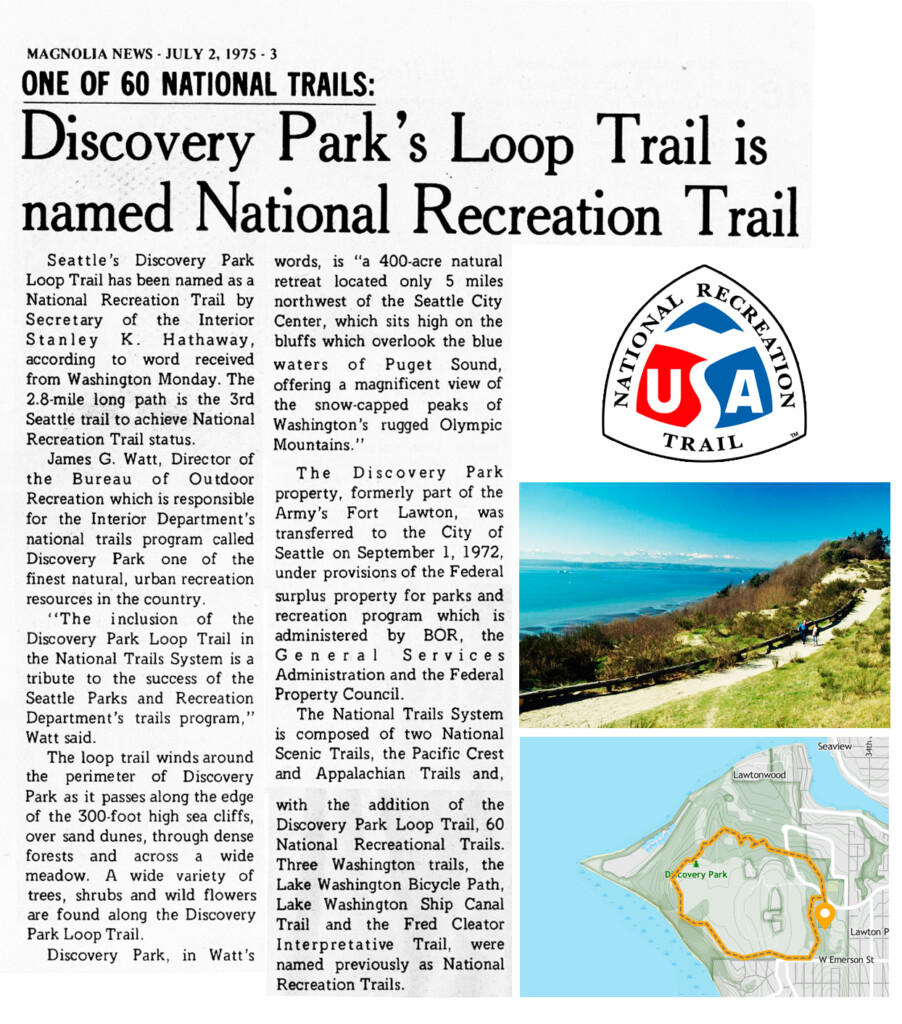
From the Magnolia News, July 2, 1975
The original newspaper clipping, titled “One of 60 National Trails: Discovery Park’s Loop Trail is named National Recreation Trail,” offers a fascinating snapshot of Discovery Park just two years after its opening. It notes that the Loop Trail was one of just 60 National Recreation Trails in the country at the time and highlights the landscape features that made the trail distinctive.
The full article reads:
Seattle’s Discovery Park Loop Trail has been named as a National Recreation Trail by Secretary of the Interior Stanley K. Hathaway, according to word received from Washington Monday. The 2.8-mile long path is the 3rd Seattle trail to achieve National Recreation Trail status.
James G. Watt, Director of the Bureau of Outdoor Recreation which is responsible for the Interior Department’s national trails program called Discovery Park one of the finest natural, urban recreation resources in the country.
“The inclusion of the Discovery Park Loop Trail in the National Trails System is a tribute to the success of the Seattle Parks and Recreation Department’s trails program,” Watt said.
The loop trail winds around the perimeter of Discovery Park as it passes along the edge of the 300-foot high sea cliffs, over sand dunes, through dense forests and across a wide meadow. A wide variety of trees, shrubs and wild flowers are found along the Discovery Park Loop Trail.
Discovery Park, in Watt’s words, is “a 400-acre natural retreat located only 5 miles northwest of the Seattle City Center, which sits high on the bluffs which overlook the blue waters of Puget Sound, offering a magnificent view of the snow-capped peaks of Washington’s rugged Olympic Mountains.”
The Discovery Park property, formerly part of the Army’s Fort Lawton, was transferred to the City of Seattle on September 1, 1972, under provisions of the Federal surplus property for parks and recreation program which is administered by BOR, the General Services Administration and the Federal Property Council.
The National Trails System is composed of two National Scenic Trails, the Pacific Crest and Appalachian Trails and, with the addition of the Discovery Park Loop Trail, 60 National Recreational Trails. Three Washington trails, the Lake Washington Bicycle Path, Lake Washington Ship Canal Trail and the Fred Cleator Interpretative Trail, were named previously as National Recreation Trails.”