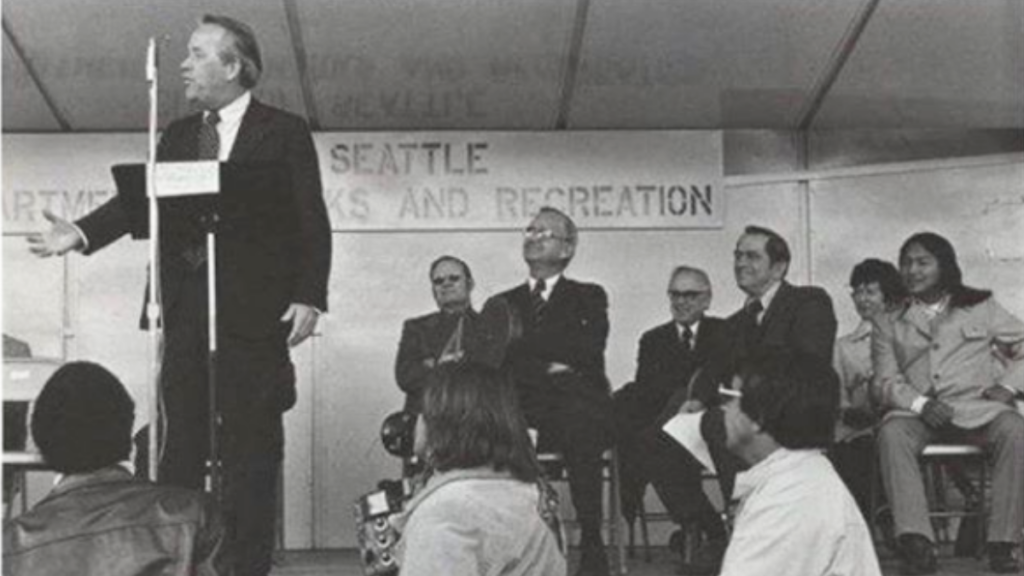
On September 2, 1972, Seattle celebrated a milestone decades in the making. The front page of The Seattle Times proclaimed:
“Finally, It’s Fort Lawton Park.”
The accompanying subheadline read:
“Patricia Nixon Cox, darts in and delivers deed.”
Ironically, this was the culmination of a huge amount of work by Senator Henry “Scoop” Jackson, a short-lived presidential hopeful against President Richard Nixon that same year. From the Magnolia News in September 2012.
From Military Installation to Public Park
Established in 1900, Fort Lawton served as a U.S. Army post for more than 70 years. As military operations changed in the mid-20th century, much of the property was declared surplus by the federal government, creating a rare opportunity to preserve hundreds of acres of open space within Seattle.
Many envisioned a different future for the site. Rather than allowing extensive development, community members, conservation advocates, and civic leaders argued that the land should become a public park where future generations could experience forests, meadows, beaches, and wildlife close to the heart of the city.
That vision ultimately became Discovery Park.
A Victory Made Possible Through Advocacy
The transfer of Fort Lawton was far more than a ceremonial event — it was the culmination of years of public advocacy and political leadership.
Among those who played a critical role was Senator Henry “Scoop” Jackson, whose efforts helped secure the transfer of federal land for public use. Local residents, environmental advocates, and civic organizations also worked tirelessly to preserve the property as open space rather than see it permanently developed.
Although Patricia Nixon Cox, daughter of President Richard Nixon, formally delivered the deed during the dedication ceremony, the achievement reflected years of collaboration among elected officials, community advocates, and countless Seattle residents who believed the city needed a place where nature could thrive alongside a growing urban population.
The Legacy Continues
More than fifty years later, Discovery Park continues to fulfill the vision established during those early planning efforts. Its forests, meadows, beaches, wetlands, and bluffs provide habitat for wildlife, opportunities for recreation, and moments of quiet reflection for hundreds of thousands of visitors each year.
Protecting that vision remains at the heart of Friends of Discovery Park’s mission. Through restoration projects, education, volunteer stewardship, and advocacy, we continue working to preserve the natural character that made Discovery Park possible in the first place.
To learn more about the park’s remarkable history, visit our History page. You can also explore how the landscape has changed over the past century in Fort Lawton Circa 1930: A Glimpse into Discovery Park’s Past.
Stay connected with Friends of Discovery Park by signing up for our newsletter to receive stories, volunteer opportunities, restoration updates, and news about the park’s ongoing stewardship.