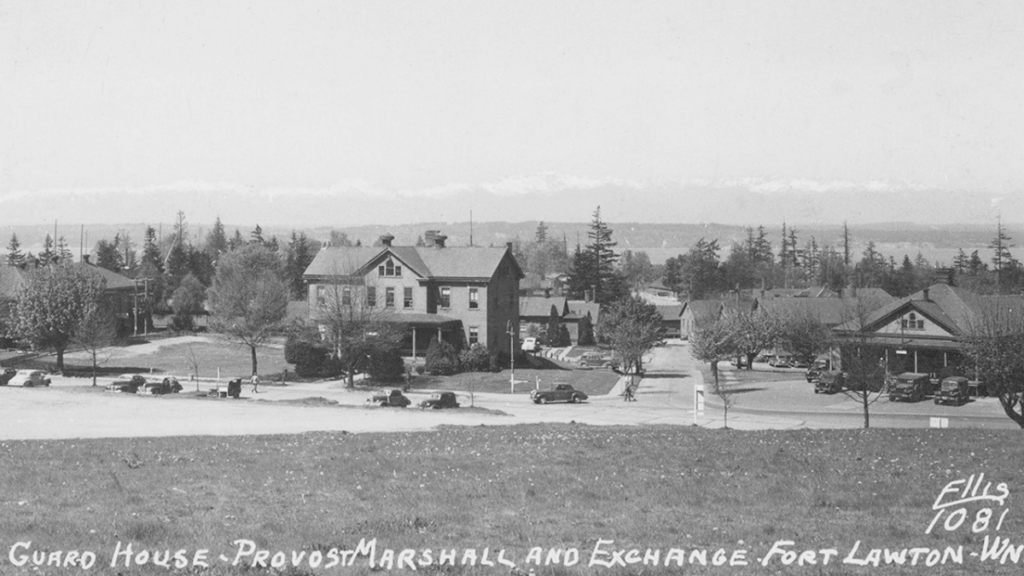
This historic photograph offers a remarkable glimpse of Fort Lawton around 1930 and provides an opportunity to see just how dramatically the landscape has changed over the past century.
A View Through Time
One of the first things many people notice is the growth of the forest. Areas that were once open military grounds are now filled with towering trees, creating the forests, meadows, and wildlife habitat that define Discovery Park today. And while the landscape has transformed, one feature remains timeless — the magnificent Olympic Mountains, still visible across Puget Sound on clear days.
Drag the slider left and right to compare the historic photographs with the same landscapes today and see just how dramatically the park has evolved.
From Fort Lawton to Discovery Park
Established in 1900, Fort Lawton served as a U.S. Army post for much of the 20th century. The installation played important roles during both World Wars, serving as a training, transportation, and logistical center for military operations in the Pacific Northwest.
By the late 1960s, much of the property was declared surplus by the federal government. Community leaders, conservation advocates, and civic organizations recognized a once-in-a-generation opportunity to preserve the land as public open space rather than allow it to be developed.
Following years of public planning and advocacy, much of the former military property became Discovery Park, which officially opened in 1972. Today, the park encompasses more than 500 acres of forests, bluffs, beaches, meadows, and wetlands, making it Seattle’s largest public park and one of the region’s most important urban natural areas.
Looking at the Landscape Today
Comparing this historic image with the park today reveals more than just larger trees. It tells the story of a landscape that has evolved from a military installation into a thriving urban wilderness where wildlife, native habitats, and people can coexist.
The continued growth of Discovery Park’s forests is a testament to decades of restoration, stewardship, and community advocacy to protect this extraordinary place.
To learn more about Discovery Park’s transformation from Fort Lawton, visit our History page. You can also explore the story behind the park’s creation in our post, “Finally, It’s Fort Lawton Park.”